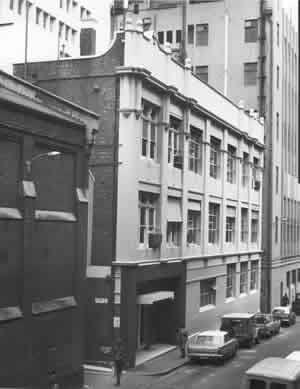
59
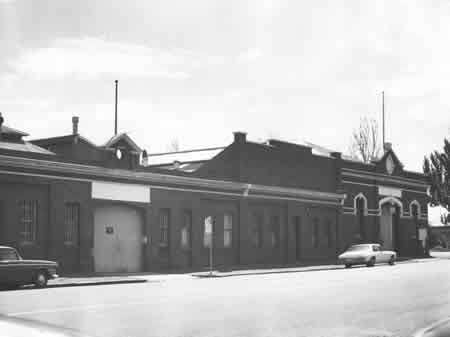
Little Collins Street,
Melbourne.
Circa 1958
(click
for larger picture)
History of the Telstra Research Laboratories
|
Accommodation
Early years
Accommodation
crisis
A
plan for the future
Temporary
accommodation
Downsizing
Field
sites
The first Laboratories accommodation was provided in 1923 when Sidney Herbert Witt was appointed as the head of a Research Section of the then Postmaster-General's Department (PMG). The one-man Research Section was allocated 300 square feet of space in the attic of the old Commonwealth Offices building in Treasury Place, Melbourne.
In 1924, when the staff increased to two, the embryo Laboratories moved to a larger area of 1,600 square feet in Melbourne House, 360 Post Office Place, Melbourne.
In 1925, with an increase in staff to five, this area was increased to 5,000 square feet.
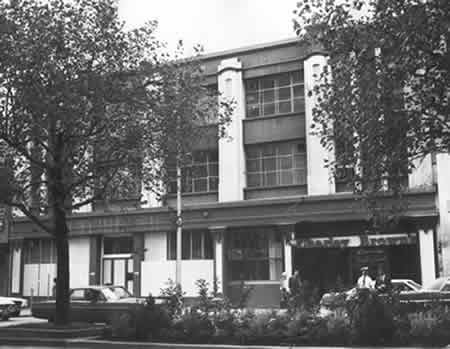
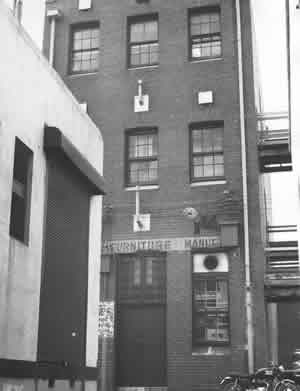
By 1932, the staff had increased to 35 and they had outgrown the space in Melbourne House. They moved into a larger area of 24,000 square feet at 59 Little Collins Street, Melbourne which became the headquarters of the Laboratories base for the next 55 years.
In 1936, James Fisher, later known as the “father of television”, joined the Research Laboratories. In his memoirs, he said of Sidney Herbert Witt:
“The Supervising Engineer, Mr S. H. Witt, was a small man, slightly built with impeccable manners. His thick growth cf black hair was always brushed smoothly back from a high forehead. He gave the impression of an enormous reservoir of suppressed vitality, with piercing eyes and a slightly aquiline nose. He spoke softly, but forcibly. My first session with him lasted 90 minutes and he talked about all the work of the laboratories, founded by him in 1923. His favourite saying was "There is no substitute for enthusiasm" of which he had plenty”.
In 1936, Fisher was looking for accommodation in Melbourne but was wary of taking a long term lease. He stated in his memoirs that:
“The possibility cf the Research Laboratories being moved to Canberra in two or three years time made me cautious about long-term commitments.”
The possibility of the Laboratories moving to Canberra was intimated many times in the years up to the late 1960’s when a firm commitment was finally made to locate the Laboratories in Melbourne (see later).
In 1947, James Fisher was given the job of specifying and locating a suitable 100 acre site near Melbourne for proposed new Research Laboratories. From aerial photographs he selected a suitable site at East Bentleigh. He recommended acquisition of the site, but no action resulted.
59
Little Collins Street, |
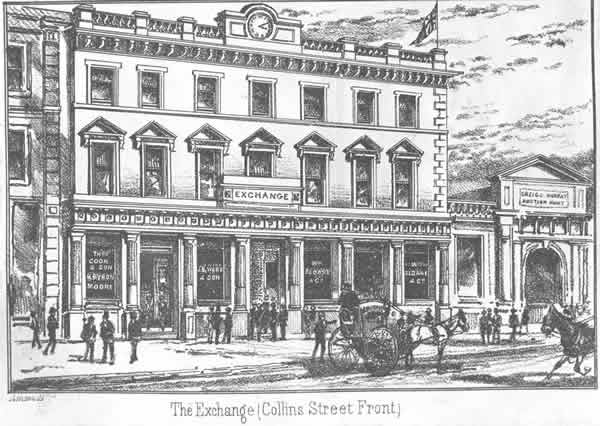
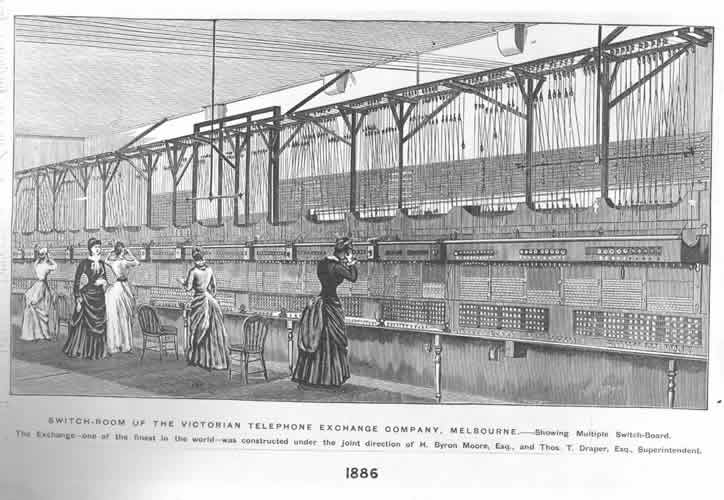
This building was originally purchased as the future home of City East Exchange and, by coincidence, it was directly opposite the building at 60 Little Collins Street which had housed the Office of the Superintendent of the first Australian telephone exchange. This manual exchange was established in 1880 under the private ownership of W. H. Masters and J. T. Draper, and was located on the site of the Old Stock Exchange.
The
first Australian telephone |
Inside
the first Australian telephone |
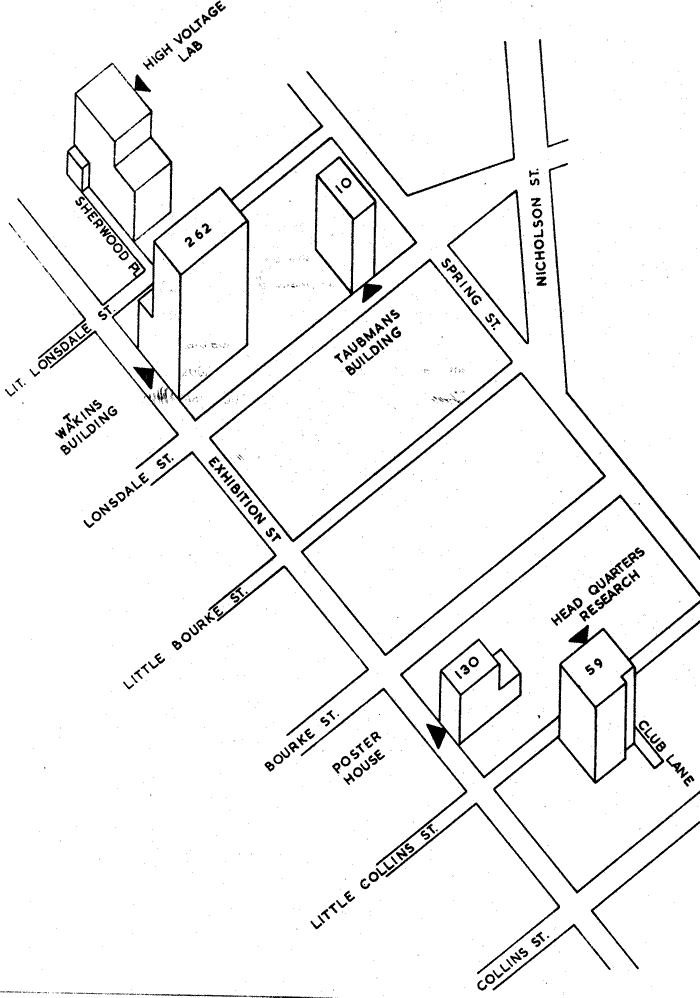
By the late 1950's, the Laboratories staff were at 200, spread over five buildings in the Melbourne Central Business District (CBD).
Map
showing Laboratories |
By the 1970's, the laboratory staff numbers were over 500 with accommodation spread over eight buildings in the Melbourne CBD. Other buildings had also been utilised from time to time. These current and "other" buildings were:
59
Little Collins Street
This
was the Laboratories headquarters and the only building owned by the
Department. Acquired in 1932. See photo above.
31
Flinders Lane
One
floor became the computing centre for the Laboratories. First leased
in the 1960's.
140
Exhibition Street
Commonly
known as "Cheneys"
after the car company that first occupied the site. This building
faced towards the Southern Cross hotel, a source of much
entertainment over the years. A unique water powered lift was in the
building and still used up to the late 1970's. First leased in the
early 1960's.
117
Lonsdale Street
Commonly
known as "Southern
Motors" after
the car company that first occupied it. The ground floor was
completely flooded in 1972 when Melbourne had 100 mm of rain in 2
hours. First leased in 1970.
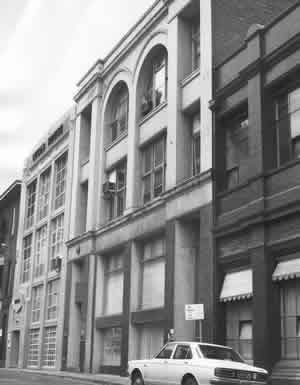
262
Exhibition Street
Commonly
known as "Watkins" after the meat works that first
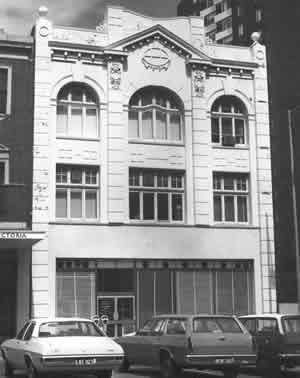
occupied it. First leased in the 1940's.
Watkins and many other
buildings were demolished to make way for the Telstra building at
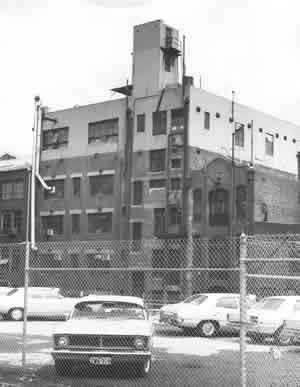
242 Exhibition Street. However, the rear brick shell of Watkins was
preserved
in an atrium like space overlooking the internal food court within
the 242 "building"
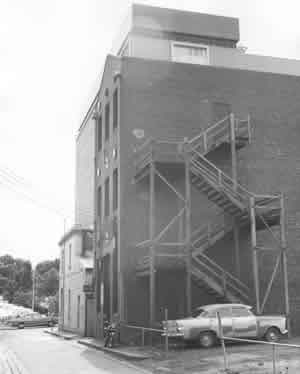
Front
of 262 Exhibition Street, |
Rear
of 262 Exhibition Street, |
51
Latrobe Street
First
leased in the late 1950's. The 1st and 2nd floors were used as a
training annex for technical staff. Trainees entered the (then)
Postmaster Generals Department (PMG) as "Technicians
in Training"
and embarked on a 5 year course. The first few years were spent at
the training annex. The building was demolished in the late 1960's.
28
Little Leichardt Street
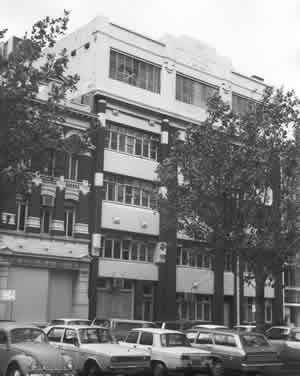
First
leased in the late 1960's as a replacement for 51 Latrobe Street
after it was demolished. The Ground floor housed the Labs battery
group. The 1st floor housed the Labs PCB facility and the 2nd floor
was the second Labs training annex. After 1977, no more trainees
were recruited and the training annex was no longer required.
See this
information about 28
Little Leichardt Street by Colin Barling.
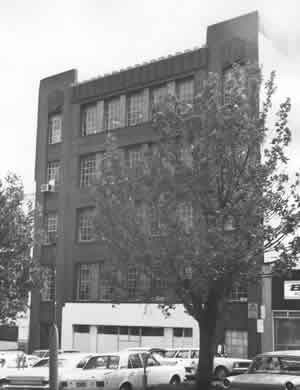
Front
of 28 Little Leichardt Street, |
Side
of 28 Little Leichardt Street, |
10
Lonsdale Street
Commonly known as "Taubmans"
after the paint manufacturer that first occupied it. First leased in
the 1950's.
1007/9
Rathdowne Street
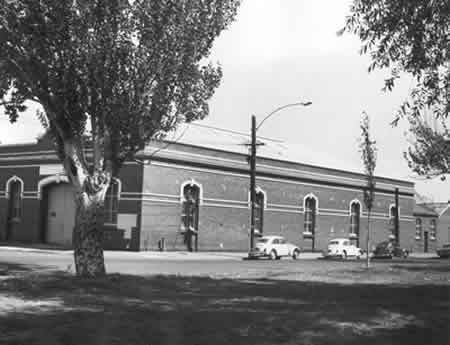
Originally a Cable Car terminus building.
First leased in the mid 1960's. Used as a base for Environmental
Physics and general storage.
Front
of 1007/9 Rathdowne Street, |
Rear
of 1007/9 Rathdowne Street, |
130
Exhibition Street
Commonly
known as "Poster
House". First
leased in the 1950's. Lease terminated when Cheneys was leased.
A building in
Sherwood Place (a laneway off Lt. Lonsdale Street)
Used
to store Environmental Physics equipment until Rathdowne Street was
leased in the mid 1960's.
In the late 1960's, the Laboratories management recognised the need to plan for future accommodation needs. The current suite of buildings were old, mostly leased and generally not suited to Laboratories work. In 1968, a policy decision was made to re-establish and consolidate the Laboratories in specially designed buildings as soon as possible. Two sites were initially selected for the purpose, one at South Melbourne and one at Clayton near Monash University. Preliminary plans envisaged the consolidation of "development" activities at South Melbourne and "research" activities at Clayton.
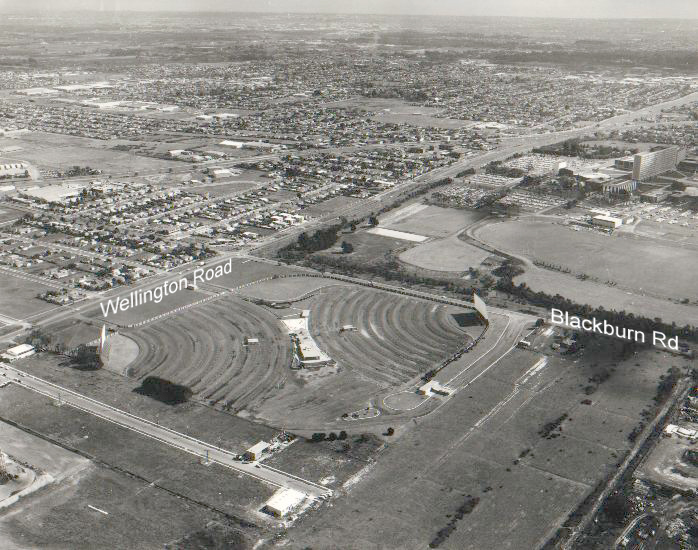
Feasibility studies indicated that significant advantages would be gained by grouping all of the Laboratories activities on one site. Consequently, in 1972, a 7 hectare site was purchased in Blackburn Road, Clayton.
Undeveloped
site in Blackburn Rd., |
A submission was prepared
for building a new special purpose Laboratories complex complete with
a plan to progressively move to the new site. Copy of submission:
 Proposed
Research Laboratories Monash, North Clayton, Victoria, Stage 1
(31 pages)
Proposed
Research Laboratories Monash, North Clayton, Victoria, Stage 1
(31 pages)
Things of interest to note in the submission are:
Details about some of the CBD buildings that were being utilised
Aerial photograph of the site showing the original drive-in complex
Plans for future development shows buildings covering most of the drive-in site
The logo on the cover page of the submission. This logo was created for the Research Laboratories on the occasion of the Golden Jubilee - 50 years of establishment
A further 12 hectares adjoining the 7 hectare site was also purchased for long term development. This site was later sold to Monash University.
See models of the proposed building layout here and here.
Leases on three of the buildings in Melbourne were due to expire in 1974 so Laboratories Management decided to relocate the staff in these buildings to leased office and laboratory space in a complex known as "Lyon Park" in Winterton Road, Clayton. This complex was close to the proposed new site in Blackburn Road and was intended to be temporary accommodation until construction of the buildings in Blackburn Road was complete.
A "Lyon Park" committee was established to represent the staff interests in the move to Lyon Park and they were successful in gaining compensation, flexible hours, a cafeteria and landscaped grounds for the Winterton Road Clayton staff. The staff at the Winterton Road Clayton Research Laboratories were the first Government Department to have flexible hours and it was seen as test case for the rest of the Public Service.
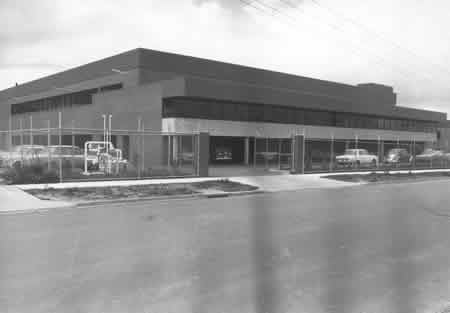
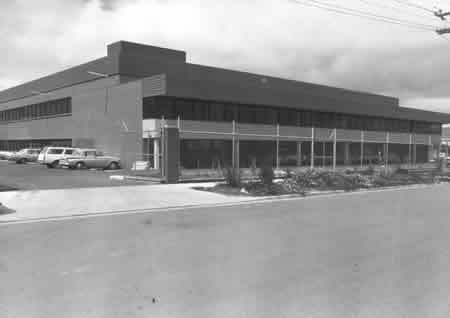
In 1975, the first groups moved from Melbourne to Winterton Road Clayton into two buildings known as Blocks CS and CN.
TRL
"CN" building in Winterton Rd., |
TRL
"CS" building in Winterton Rd., |
The owners of 140 Exhibition Street (Cheneys) had been attempting to remove the Laboratories from the building for a number of years prior to 1975. They intended redeveloping the site and had taken out a building permit which would expire before the Laboratories intended moving out. The Laboratories resisted moving, preferring to wait until the accommodation at Lyon Park was ready. It was thought that the Laboratories were paying exorbitant rent in the latter years. This led to the extraordinary situation where some renovations commenced in the building before the Laboratories had moved out, thus keeping the building permit active.
Construction of Stage 1 at
Blackburn Road commenced in 1973 and was completed in 1978, when the
official opening was held. In that year, the first Melbourne based
groups moved to Blackburn Road, Clayton.
For the official
opening, a brochure was produced:
Official
Opening of Telecom Australia Research Laboratories Complex
(15 pages)
The
opening was also reported in the July
1978 issue of the Telecom Magazine.
The second stage of the Blackburn Road buildings was completed in 1983 when the remainder of the Melbourne based groups moved to Blackburn Road.
The Clayton buildings consisted of 6 special purpose buildings named M1, M2, M3, M4, M5 and M6. The brochure above provides further details of the buildings.
The last building constructed on the site was M8, containing the administration, library and cafeteria complexes. M8 also included a sophisticated auditorium, the first specially designed presentation complex in the history of TRL. The M8 foyer was fitted out with a static presentation of Telstra research activities. In 2001, the foyer area was upgraded and given the title of "Technology Showcase" - a centrepiece for Telstra's R&D tours program. Before M8 was constructed, the cafeteria was located in M1.
The Winterton Road site was finally vacated in 1990 when remaining staff moved to the Blackburn Road complex.
In 1996, the Laboratories experienced a 30% cut in staff with work in some areas discontinued. This left the Laboratories with an excess of space. About the same time, the Global Operations Centre of Telstra were looking to consolidate their operations in Victoria and the Laboratories site was an ideal location. By 2001, the Global Operations Centre had taken over three buildings, increased parking space and improved site security. The Henderson Road entrance was also opened.
In 1999, a section of the Laboratories moved back into the Melbourne CBD.
In 2002, the original guard house was demolished and a new one erected adjacent to building M2.
Following a staff suggestion, Laboratories management agreed to a proposal to name roadways on the Monash site after Laboratories Directors.
Staff cuts continued and in 2005 TRL was officially closed. In 2007, the last TRL persons left the site and the buildings were later demolished. See here for more information about the closure.
Over the years, the Laboratories have utilised field sites all over Australia, both manned and unmanned.
Two notable sites were:
Nullabor
Plain
In
the late 1960's, a number of sites
were established on the
Nullabor Plain to perform propagation measurements in preparation for
a proposed East-West microwave link. Once the sites were setup, teams
of 2 persons spent 2 weeks living on site maintaining equipment and
performing measurements. At the end of the 2 weeks, they would drive
to the "Indian
Pacific"
railway line, leave the vehicle there and catch the train back to
Melbourne. A new team would arrive and drive the vehicle back to the
test site. This system continued for a number of years.
Back at
the Laboratories, a large team worked full time analysing measurement
results.
"Clear Across Australia" was a film made by Morris Murphy about the planning, training, propagation tests and installation/testing of the East-West microwave link in the late 1960's and early 1970's He was a cinematographer in the PMG. The National Film and Sound Archive have a copy.
Windsor
In
1973, the Laboratories commissioned a field trial of an Integrated
Switching and Transmission (IST) model exchange, the first fully
electronic exchange to switch live telephone traffic in Australia.
The model exchange was fully designed and built in the
Laboratories.
The exchange was first housed in Windsor telephone
exchange but later moved to a tin shed at the rear of St Kilda
telephone exchange. Some of the normal telephone traffic through St.
Kilda exchange was siphoned off and passed through the model
exchange.
For nearly 20 years, Laboratories staff monitored and
assessed the digital switching equipment until the trial was closed
in 1991.
Other well used field sites
were at:
Caldermeade, The Gurdies, Mt. Cotteral, Innesvale,
Cloncurry and Darwin.
In the 1980's, with advent of cheap computing facilities, remote monitoring of field sites increased, thus reducing the need to visit remote sites as often.
By 2003, the Laboratories had very few field sites remaining.
In December 2005, TRL was officially closed.
See also:
Closure
of TRL. About
80% of the staff accepted redundancies and the rest obtained
positions in other areas of Telstra.
The
Big Walk The
story of three intrepid staff who, on their first day at the new
Clayton site, walked to Clayton from their old building in the
Melbourne CBD carrying the old buildings name plate.
Last updated: Aug 2026